
Lerner Child Development Blog
Open access to my full library of over 150 blogs is now available by becoming a member of Lerner Child Development (LCD). Scroll through thumbnails below or see the button to explore all the blogs by topic.
This subscription service enables me to continue to provide in-depth, reality-based content drawn from more than three decades of helping families solve their most vexing childrearing challenges.
In addition to access to my blogs, subscription to LCD includes several new interactive learning opportunities with me each month: a live, open Q&A and quarterly webinars on key topics. Members are also entered for two monthly drawings for a free 30-min consultation.
Note that I have made some of my most popular blogs available for free.
Blogs By Categories
- All Most Popular Blogs
- Big Reactors
- Building Resilience
- Challenging behaviors
- Cooperation
- Emotional Regulation
- Food Challenges
- Highly Sensitive Children
- Limit-Setting With Love
- Low Frustration Tolerance
- Mealtime
- No Power Struggles
- Parental Self Awareness
- Parental Self Regulation
- Physical Aggression
- Positive Discipline
- Potty Learning
- Regression
- School Related Issues
- Separation and Divorce
- Sibling Issues
- Sleep
- Social challenges
- challenging behaviors
- lying
- masking
- positive parenting
- separation anxiety
- social emotional development
- stress

"Mommy, You Are A Toilethead!" Why Not to Take Your Child's Words and Actions At Face Value
I am going to go out on a limb and assume that many of you who take the time out of your busy days to read this blog have a big reactor under your roof, who has been known to hurl vitriol ("You are a toilethead", "You don't belong in this house anymore") and/or is aggressive with her body--hitting, kicking, biting. No doubt, these are among the most vexing challenges parents face. And no doubt, these big reactors need to learn to express their emotions in more acceptable, healthy ways.
As I work with families to attain this important goal, a major obstacle almost always emerges: the parents' mindset. Moms and dads are interpreting and then reacting in these moments as if their child harbors malicious intent; that he means to be harmful with his words and his body. This triggers a harsh, punitive and shaming reaction that only reinforces these unwanted behaviors.
This excerpt from my new book, Why Is My Child In Charge? elucidates this mindset, and the mindshift that enables you to stay calm, not further escalate the situation, and ultimately teach your child how to effectively manage his big emotions.
MINDSET: My child harbors malicious intent when she is aggressive with her words and actions.

Keys To Decoding Kids' Behavior: Development, Temperament and Context
When I collaborate with families to solve the childrearing challenges they are facing, we start by doing the detective work of putting the pieces of the puzzle together that help us understand the meaning of their child's behavior. Only then can I provide guidance that is developmentally appropriate and effective, because it addresses the root cause of the challenge. One-size-fits-all approaches that simply address a behavior, absent an understanding of the function and meaning of that behavior, is rarely effective. Indeed, most families who come to see me have already tried prescriptive approaches to stopping tantrums or getting their kids to sleep. When these systems don't work, parents feel they have failed and despair that they won't find a way to successfully solve these challenges.
Below I lay out the key factors for decoding the meaning of your child's behavior to enables you to devise strategies that address the underlying issues at work. This opens the door to being the loving, in charge parent your kids need you to be.
KEY FACTORS

Why Children Are Superstars At School and Terrors At Home
Multiple times a week I talk with parents who report the following: their kids are superstars at school—calm, cooperative, collaborative—but are terrors at home. They break down over seemingly minor issues, don't "listen", and are very inflexible and demanding. Like Eva, 4, whose teachers report that she is one of the most cooperative and best helpers in the class. She is kind to her friends and is good at sharing. She is empathetic—always the first one to comfort a peer who is struggling. In short, she is a total delight. At home it is a very different story. Eva is demanding. She ignores her parents' directions, and she melts down if she can’t have what she wants, when she wants it.
Eva’s parents are thrilled that she is doing so well in school; but they are perplexed and angry that she “chooses” to be so difficult at home when she clearly has the ability to show much more self-control. They are at a loss for how to make sense of their Jekyll-and-Hyde daughter and how to get her to behave at home as she does in the classroom.
While this phenomenon is confusing and maddening to parents, when you look at it from your child’s perspective, it begins to make sense and opens up the door to responding in ways that can increase cooperation and reduce power struggles at home.
See It From Your Child’s Point-of-View

Helpful Hacks: Not-so-tiny victories from the parenting trenches
Read stories from my practice that show how to help kids: work through fears; going through the loss of a grandparent; build frustration tolerance; adapt to a new baby in the family; get comfortable pooping on the potty.

Feelings Are Not The Problem: How to help children learn to manage ALL their emotions
We love our children so deeply and what we want most is for them to be happy. So when they share difficult or uncomfortable feelings, our typical knee-jerk reaction is to try to change their feelings by minimizing or talking them out of their emotions: "Don't say you're stupid! You are the smartest kid I know."
This impulse is so strong because at a cellular level, it feels like it’s harmful to our children to feel sad, angry, jealous, or insecure. They tell us they don't want to go to a new school so we jump in to explain all the ways it is going to be so much more awesome than their old school. They express worry about going to swim class so we quickly counter that there is nothing to be scared of.
Or, we are uncomfortable with emotions that seem "mean" or "wrong". "You don't really want the baby to go back to the hospital! You love your little brother."
Whatever the trigger, we just want to make the uncomfortable feelings (for them and us) go away. We fear that acknowledging them amplifies them. But ignoring or minimizing feelings doesn’t make them magically disappear. In fact, without a healthy opportunity for expression, feelings get acted-out which can lead to more, not less stress for your child…and you. They say they have a belly ache and can’t go to school. They refuse to get in the pool at swim lessons.
Further, when children don't get their feelings validated, they up the ante to be heard. Five-year-old Remi announces that she thinks her drawing is ugly. Her mom replies: "But I love your drawing, it's beautiful!" Remi's response: "You don't know anything about art. This is a terrible picture", and proceeds to rip it to shreds.
The major mindshift to make is that feelings are not harmful to children. Sadness and joy, anger and love, pride and self-doubt, jealousy and empathy can coexist and are all part of the complex collection of emotions that makes us human. Our job is not to rid or protect our children from their difficult emotions (which is actually not possible), it is to help them understand and effectively cope with ALL of their feelings. Shutting down the process is a missed opportunity to help children make sense of, not fear, their feelings. What kids need when they are distressed is precisely what we need in these moments: someone who listens, accepts our feelings, doesn't judge, and doesn't tell us what to do or try to make it all better. Someone who can sit with our uncomfortable feelings and trust that we have the capacity to work them through, with their support.
When we avoid or minimize our children’s feelings, we interfere in this process. We send the message that we are uncomfortable with their difficult emotions and don't want to hear about them. This makes it less likely children will share their feelings with us, depriving them of a chance to express and work them through.
Consider the following story:

How to End Mealtime Madness Part 2: No more battles over dessert
Duane and Melanie are trapped in daily food battles with their four-year-old, Mathius, over whether or not he has eaten enough growing foods to have a sweet dessert. Dinnertime is consumed by Mathius’s constantly announcing that he’s ready for dessert while his parents demand that he take “one more bite.” He nibbles at a piece of food and insists that this qualifies. Duane and Melanie find themselves debating whether this meets their criteria. They eventually get worn down and give in, albeit with a good dose of annoyance at Mathius for manipulating them and putting them in this position of having to cave on limits they think are important in order to keep the peace at mealtime.
Battles like this over dessert are a perennial problem for many families. Like Duane and Melanie, the major pitfall that perpetuates this dynamic is parents trying to change their child’s behavior—to get him to agree to eat more growing foods so they don’t have to deal with the inevitable battle over dessert. Further, their interpretation that their child’s behavior is manipulative—that he is forcing them to give him what he desires—leads to anger and frustration which only fuel the power struggle and interfere in parents’ ability to think clearly about the situation and make a better plan.
Once you accept that you can’t make your child change his behavior, and that he is just being strategic to get his way (which is working) you are positioned to set and enforce limits you actually have the power to control. You can’t make your child eat more growing foods, but you can limit sweets, even if he doesn’t like it. Remember, just because your child doesn’t like a limit doesn’t mean it’s not good for him.
The Plan

Understanding and Supporting Highly Sensitive Children (HSC)
Our five-year-old, Gabriel, is a very bright, funny, charming little guy. But he still has a lot of tantrums, which we thought would be over by this age. He reacts very poorly to consequences. He will get very threatening and aggressive physically and verbally: slamming doors, hitting, and lashing out verbally. We are constantly negotiating with limit setting. When we hold to the limit, he will escalate and sometimes will have very intense tantrums that can last over 30 minutes. When he is happy, he is the most delightful child. But the second something doesn’t happen exactly how or when he wants it, he is explosive. We are totally exhausted.
Gabriel is also very sensitive and self-conscious. He is easily offended. He doesn’t like people focusing attention on him or looking at him. Every single performance he has participated in he turns his back away from the audience. He is also a perfectionist and will be very self-critical when he doesn’t do things perfectly.
Gabriel feels rejected easily. For example, the other day I was giving his little sister a piggyback ride down the stairs in the morning. He went under his covers and started screaming all sorts of inflammatory and threatening things. When I try to talk to him about these incidents, he covers his ears. If we try to ignore his inappropriate language, he will just escalate. He eventually calms down and feels badly about his behavior. When we process it once the explosion is over, he will say things like “I push people away, like Elsa (of Frozen).” Or, “My brain is so out of control…I don’t know why I stay so mad.”
Most parents who seek my services have a Gabriel (to varying degrees) in their family. Whether the motivation to make that first call to me is for a challenge with tantrums, aggressive behavior, power struggles, sleep, or potty training, the common denominator is that their child is highly sensitive (HS) by nature, also known as temperament.
Temperament is a child’s way of approaching the world—the “why” that explains the meaning of his behavior. Temperament is something we are all born with, not something children choose or that parents create. It influences the way we process our experiences in the world. It is why some children jump right into new situations and others are anxious and need time to warm up to the unfamiliar. It is why some children go-with-the-flow and weather life’s ups and downs with ease and others have big reactions to seemingly minor events. It is also why siblings can be so different. They share DNA and grow up in the same family, but their reactions to the very same experiences—a move, a loss, their parents’ approach to discipline—may be vastly different based on their temperament.
The reason HS children tend to experience more challenges is because they are wired to register their feelings and experiences in the world more deeply than other children. Parents often describe their HS children as being either ecstatic or enraged—with no middle register. They are sometimes referred to as “orchids”[1] because they are affected by and reactive to even minor changes in their environment. They are more vulnerable than the kids we call “dandelions” who go with the flow and thrive even in challenging circumstances (and make their parents looks so good!)

How to End Mealtime Madness
Daniela and Marcel are very keen on making dinner time family time. But their almost four-year-old, Reuben, resists sitting at the table for more than a few minutes. He keeps getting up to play. Daniela and Marcel try negotiation/bribery: “If you sit for five minutes and eat six bites of chicken and three of broccoli, you can have extra dessert”; threats: “No books before bed if you don’t sit down and eat”; and logic: “You are going to be hungry if you don’t eat enough.”
None of these tactics is working, so Marcel and Daniela have started to allow Reuben to bring a tablet to the table and play games, despite the fact that they had sworn never to allow any screens during mealtimes. (Marcel wonders, “How is it that my three-year-old is extorting me??”) At the same time, they feel very sad about the fact that a fair share of the precious time they have with Reuben at the end of the day is spent with him diverted by a screen, but they feel helpless to effect a change. Without the incentive of the tablet, they don’t see how they can get Reuben to stay at the table for longer than two or three minutes. Even then, he is so distracted by the screen that he still doesn’t eat, provoking further power struggles. Daniela and Marcel are at a loss as to how to turn this mealtime situation around to create the kind of experience they feel would be healthy and loving for Reuben, and for them.
Why children draw parents into food battles

Your Child Needs You to Be Responsive, Not Reactive: Here’s How
Dev is trying to read books to his three-year-old, Zoara. Zoara is running around the room and not settling down to participate. She keeps demanding that mommy (Nurit) come back to read to her. Dev spends 20 minutes trying to get Zoara to change her behavior, then reaches his threshold and storms out of the room in frustration. Zoara starts to scream that she didn't get her books and begs for Nurit who goes to Zoara, settles her down, reads to her and puts her to bed. This has become a pattern: Zoara demanding mommy do bedtime every night and rejecting Dev.
Dev and Nurit know that this dynamic is unhealthy for everyone, but they feel stuck. Dev is so upset in the moment that it's hard for him not to be reactive. For Nurit's part, she has a hard time not going to Zoara when she's screaming for her.
In my work collaborating with families to solve their most vexing childrearing challenges, I have identified a number of consistent parental mindsets that result in moms and dads getting triggered and reacting in ways that are ineffective and often increase the intensity and frequency of meltdowns, power struggles, and other challenging behaviors.
One of the most prevalent of these faulty mindsets is: "I can and need to control my child. I have the power to change his behavior."
But the fact is that you cannot actually make your children do anything: eat, sleep, use the potty, be kind, not yell or have a tantrum. Children, like all humans, are the only ones who control their words and actions. This is one of the most humbling aspects of parenting that no one warns you about. It is so fiercely counter to how we see ourselves and our role. We are supposed to be able to make our children behave.

What Your Child Really Needs: Lessons from my own parenting journey
Just as I was thinking about what to share in my final blog of 2020, I had a consult with a couple that provided the spark. Mid-session, the mom burst into tears as she shared how ashamed and saddened she was at the relief she experienced upon finding that her son had fallen asleep while waiting for her to come say goodnight. The prospect of having some alone-time instead of the seemingly endless ordeal of trying to get him to go to sleep was a dream come true. But instead of enjoying her much-deserved respite, she was self-flagellating, wondering what kind of mom she was if she was happy to have time away from her child. This was decidedly not the mother she had dreamed of being.
This broke my heart. This is a thoughtful, sensitive, loving mom who is trying to balance caring for a feisty toddler and a 4-month-old while getting ready to return to work after the new year. She is exhausted and depleted, which is further exacerbated by feeling ashamed at wanting relief from her child who is very demanding. She just wants him to be happy. She gives and gives but feels like it’s never enough.
This conversation became the impetus for this blog, as I know from my consults with hundreds of parents during the last nine months that this mom is not alone, and that many of you are probably experiencing these kinds of feelings to some degree. It is a list of some of the most important lessons I have learned about what children really need—things I wish my younger self had understood that would have reduced stress and enabled more joy.

Positive Parenting Mindshift: Your Child is Strategic, Not Manipulative
This blog is part of a series based on my 2021 book, Why Is My Child In Charge? Through stories of my work with families, I show how making critical mindshifts empowers parents to solve their most vexing childrearing challenges, including: tantrums, aggressive behavior, sleep, mealtime battles, and potty learning. Most importantly, it shows you how to get back in the driver's seat--where you belong and where your child needs you to be.
When my child tries to get her way, she is being manipulative.
Luca and Scott walk into my office and announce that they have a master manipulator living in their home. They explain that they had established what they wanted to be a hard and fast rule that there would be no screen time for their daughter, Sophie (4), in the mornings before school.
But Sophie refuses to get dressed unless they let her watch an episode of Peppa Pig while she puts her clothes on. Every morning it’s the same scenario: Luca and Scott ask Sophie to get dressed. She demands Peppa. They remind her there is no TV in the morning. They tell her they will come back in five minutes and expect her to be dressed. When they return, Sophie is just messing around in her room and announces: “I need Peppa!” They get annoyed and start raising their voices, telling her they are going to be late and that she needs to cooperate!
After a prolonged power struggle, it always concludes the same way: the clock is ticking, so to get everyone to their destination on time, Luca and Scott give in and turn on the show. They are angry at Sophie for putting them in this position and “extorting” them. They wonder how they have gotten to a point where a four-year-old can wield so much power and control the family in this way.
_________________________________________________________
Three-year-old Joseph is pushing the limits around bedtime, demanding an increasing number of books and songs and then calling out with a litany of problems he needs fixed, such as his blankets being messed up or the animals on his shelf not being positioned the way he wants them to be. Joseph's parents are getting increasingly annoyed with Joseph and are feeling manipulated. He is calling all the shots and they are angry at him for making them feel out of control. They don’t know how to turn it around.
Making the Mindshift

Positive Parenting Mindshift: Your Child Isn't Misbehaving on Purpose
This blog is the second in a series based on my 2021 book Why is My Child in Charge? A Roadmap to End Power Struggles, Increase Cooperation, and Find More Joy in Parenting Your Young Children.
Through stories of my work with families, I show how making critical mindshifts—seeing children’s behaviors through a new lens —empowers parents to solve their most vexing childrearing challenges, including: tantrums, aggressive behavior, sleep, mealtime battles, and potty learning. Most importantly, it shows you how to get back in the driver's seat--where you belong and where your child needs you to be.
This installment focuses on the mindset that… My child is misbehaving on purpose. He should be able to accept limits and exhibit greater self-control.
Kishan takes his three-year-old daughter, Seema, to the pool several times a week in the summer. Even though Kishan gives Seema a five-minute warning before it’s time to get out of the pool, when time is up, Seema says she hasn’t had enough swimming and needs five more minutes. When Kishan says no, she calls him mean and starts to pout. In a desperate attempt to stave off a tantrum, Kishan relents and gives Seema the extra time, but that changes exactly nothing. Seema still refuses to get out. Kishan tries bribery and threats—she’ll get a treat if she gets out, or she’ll lose a book at bedtime if she doesn’t get out. Nothing works. Eventually, Kishan has to drag Seema out, which is mortifying for him and, he imagines, pretty embarrassing for Seema, too. Kishan starts to dread going to the pool with her and finds every excuse not to go. They spend more time at home doing indoor things. He knows it would be better for his daughter to be outside, using her muscles, learning to swim and making new friends. He feels frustrated and sad for both of them.
If this scenario sounds familiar, you are not alone. Interactions like this play out every day in families with young children: child doesn’t follow a direction, parent tries a range of strategies to get the child to cooperate, child still doesn’t comply, parent loses it and gets punitive, child melts down, parent either feels bad and caves or angrily punishes child with no positive resolution.

Stop Trying to Control Your Child
This article is the first in a series based on my 2021 book, Why Is My Child In Charge? Through stories of my work with families, I show how making critical mindshifts—seeing children’s behaviors through a new lens —empowers parents to solve their most vexing childrearing challenges, including: tantrums, aggressive behavior, sleep, mealtime battles, and potty learning. Most importantly, it shows you how to get back in the driver's seat--where you belong and where your child needs you to be.
The spotlight in this blog is on a mindset many of you who have worked with me or have read my content have heard me talk a lot about: “I can control and change my child’s feelings and behavior.” The reason I bring it up so often is because it is perhaps the most pervasive obstacle to “positive” and effective parenting because it puts your child, not you, in the driver’s seat—a dynamic that is not healthy for anyone.
The fact is that you cannot actually make your child do anything: sleep, eat, not thrown a tantrum, agree to get in the car seat, pee in the potty…the list is endless. Children, like all humans, are the only ones who control their words and actions. This is one of the most humbling aspects of parenting that no one warns you about. It runs so fiercely counter to how we see ourselves and our role. We are supposed to be able to make our children behave.

Highly Sensitive Children: Is there a sensory piece of the puzzle?
I always thought Samantha was just more ‘intense’ than other children. Her reactions to nearly everything were incredibly strong. She threw massive tantrums at least multiple times a day over things such as having to sit in her car seat or accidentally getting water in her eyes during bath time. People would tell me tantrums were “normal,” but I felt it wasn’t normal to be having such intense tantrums so many times each day. She was incredibly impulsive. She also seemed to both seek physical input (for example, by climbing on others) while also protesting intensely any physical touch that she didn’t like (for example, an adult restraining her from an unsafe situation). She would melt down if someone else did something she wanted to do like flush the toilet, push a button, or turn on the faucet to wash hands, and she often didn’t “recover” for several minutes, even an hour at times. She also had a hard time listening to and following directions, so things like getting her dressed were often very difficult. I felt completely overwhelmed and lost.
I have found in my work that children who are highly sensitive from an emotional standpoint are also likely to be more sensitive to sensory input—to some degree. They experience sights, sounds, tastes, smells and/or textures more intensely. They may become afraid of public bathrooms because the flusher is too jarring and loud. They may reject foods that have strong tastes and smells. They may find bright lights uncomfortable.

Sore Losers: How to help them cope with competition
Leo is the worst sore loser. We can't play any family games because he goes nuts if he doesn't win. Even though he's great at soccer and makes a lot of goals, the second someone blocks one of his attempts to get the ball into the net he starts screaming that it's unfair and storms off the field. It's embarrassing and I worry about how other kids see him and if they are going to want to stop playing with him.
Being a perfectionist and having a very low tolerance for losing go hand-in-hand and makes competitive activities especially stressful for kids who struggle with these issues. To cope and protect themselves from the discomfort and shame that gets triggered when they lose, highly sensitive (HS) kids try to manipulate the game to win (aka "cheat") or they get angry and quit. In a time long ago, before COVID, I was playing Connect Four with five-year-old Lucy on a home visit. She made the first move. When it was my turn, I dropped my piece into the slot next to hers—the obvious move. Lucy immediately got revved up and explained, “No, Ms. Claire, I tell you where you can put your pieces.”
What you can do:

How to Build resilience in Children who have a low Tolerance for Frustration
Lucas (4) just got a new scooter which he has wanted for a very long time. He hops on it, but as soon as he has trouble balancing, he tosses it to the ground. He pronounces that he hates scooters, that he really never wanted one, and runs inside.
Highly sensitive (HS) children tend to experience more distress and give up more easily when they confront a challenging task or can’t master a new skill right away. The root cause, once again, is the vulnerability and loss of control that gets triggered very quickly in these kids. HS children need more support to build resilience—to see that they can muscle through challenges.
What you can do:

How to Support Children Who Struggle with Self-Consciousness and Feel More Easily Slighted
Talia (4) hates when we talk about her, even if we are praising her, like telling her what a good job she has done or describing one of her accomplishments to grandpa.
Highly sensitive (HS) children are more keenly focused on how other’s see them. Like Gabriel, whom you met in a previous blog on HS kids, who refused to participate in any class performances; and, Jonah, who didn’t want the kids or teacher in the swim class to look at him. They get very uncomfortable when any attention is called to them, even when parents or other adults are saying complimentary things. It feels overwhelming to be under any kind of scrutiny.
What you can do:
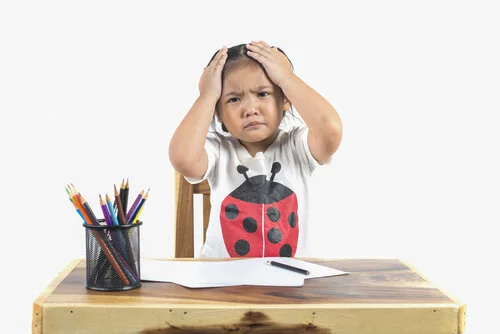
Highly Sensitive Children: Perfectionists
Gabriel (6) and I were working on writing letters together. When he couldn’t make his “O” look exactly like mine, he had a total meltdown. The more I tried to tell him what a good job he was doing, the more agitated he became.
When Serena (5) messes something up, her reaction is very disproportionate and she is incredibly hard on herself - saying she will never draw again, tearing up the paper, crying, hitting herself on the head, throwing herself on the floor. We try to model losing/not being perfect and taking it in stride - we emphasize that, but it doesn't seem to help.
Highly sensitive (HS) children have a tendency to be perfectionists. When they can’t do something exactly as their brain is telling them it should be, they experience it as a loss of control which is very uncomfortable and hard to tolerate. Hence, the meltdowns. This can be very frustrating for parents who see the irrationality in their children’s thinking but find that using logic to help them be more self-accepting backfires.
What you can do: