
Lerner Child Development Blog
Blogs By Categories
- All Most Popular
- All Most Popular Blogs
- Anxiety
- Big Reactors
- Blogs
- Building Resilience
- Challenging behaviors
- Cooperation
- Emotional Regulation
- Food Challenges
- Highly Sensitive Children
- Limit-Setting With Love
- Low Frustration Tolerance
- Mealtime
- No Power Struggles
- Parental Self Awareness
- Parental Self Regulation
- Physical Aggression
- Positive Discipline
- Potty Learning
- Regression
- School Related Issues
- School challenges
- Separation and Divorce
- Sibling Issues
- Sleep
- Social challenges
- Social emotional development
- challenging behaviors
- food
- lying
- masking
- mealtime
- parenting self-awareness
- positive parenting
- separation anxiety
- sleep
- social emotional development
- stress
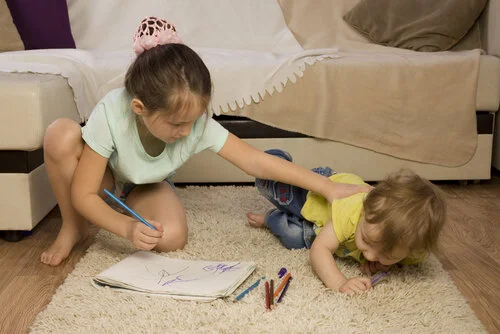
Why Can't You All Just Get Along?
“Haha—you lost!”
“Stop singing that stupid song. You’re hurting my ears!”
“YOU CANNOT PLAY THIS GAME. YOU DO NOT KNOW HOW TO PLAY!”
The sibling relationship is about as complex as it gets. Talk about the confluence of emotions that run the gamut from the extremes of love and hate. The natural conflict that arises as siblings navigate their relationship ranks as one of the most vexing challenges for parents, often sending them into reactive-mode which tends to exacerbate, not eliminate, sibling squabbles.
Since every family dynamic is different, there is no prescriptive approach to effectively addressing sibling rivalry. Instead, I offer some key guiding principles to help you avoid common pitfalls, as well as some actionable strategies for responding supportively and effectively when your kids are causing chaos, that you can tailor to your unique situation.
GUIDING PRINCIPLES

Fair is NOT Equal
A spate of parents I’ve seen recently have expressed a lot of frustration over the fact that every time they say “no” to their kids, they are accused of being unfair. This is a major trigger for parents, sending them into reactive mode. They either start to defend their decisions to their children or they give in. Both responses validate that their child’s assessment of the situation is accurate or reasonable, when in most cases it is decidedly not. For example: Jonah, 6, who protests that it’s not fair that his older brother, Sam (age 9), gets to stay up later; Stella, 4, who explains that it’s not fair that she has to sleep alone when her parents get to sleep together; and, Lucca, 5, who insists that it’s not fair that he has to share the Magnatiles with his brother who isn’t as serious about building as Lucca.
Just because in our logical minds these protestations can seem irrational doesn’t mean that your child doesn’t actually feel an inequity is taking place. In some cases, it is just a strategy to get you to change your mind and give in to something your child wants. Kids are clever and will use whatever tactics work to reach their goal. But in many cases, on the face of it, the rule does seem unfair to children—that a sibling gets to stay up later or that parents get to sleep together but the child has to sleep alone.
And sometimes there are contextual factors that we need to be sensitive to. For example, I recently met with parents who have a 6-year-old, Liam, who constantly feels like a victim. As we unpacked how he may have developed this sense of himself, it turns out that when he was a toddler, his older brother was diagnosed with a serious illness and went through three years of intensive treatment. The parents had a large group of friends and family to help. But Liam likely sensed that his parents were distracted (understandably) and consequently started building a narrative that his needs were not as important as those of his older brother. Add to that the fact that Liam now has two younger siblings, including a new baby, amplifying his worry about whether he will get the attention he wants.
It is important to be sensitive to the underlying forces that influence your children’s behavior and the lens through which they filter their experiences. Even if your kids have not gone through a family trauma like this, many experience tough periods when they are trying to make sense of their place in the family. Temperament is also a factor: children who are inflexible by nature tend to develop very fixed ideas about how things should be and thus have a very hard time when things don’t go according to their desire or plan. This often results in the refrain: “IT’S NOT FAIR!”
The goal is to help children see that not getting everything they want is about healthy and developmentally appropriate limits, not about love or favoritism. Liam’s parents want him to create a new narrative that is not one of “I am a victim, always being deprived”, but one that sounds more like, “When I can’t have everything the way I want it, and my parents set limits, it doesn’t mean I am not loved or valued.” Mature as this outlook may seem, over time, children can and do internalize this very important concept.
Below is a roadmap for responding to protestations of "it’s unfair!" that enables you to be empathetic while maintaining the limits that you feel are important for your child:

“When Is He Going Back in Your Belly?” How to Help Older Siblings Adjust to the New Baby
Aside from the expected challenges parents face in figuring out how to manage multiple children while trying to maintain their own relationship, the reaction of the first-born is often top-of-mind for parents. The good news: There is a lot you can do to help your older child adapt to a new baby in ways that maximize the chance that she will ultimately develop a close, loving relationship with her sibling.

Preparing Your Older Child for the Arrival of a New Baby
Claire Lerner, LCSW
Preparing for a second child is a little different than when you were expecting your first. One major new variable is child number one, who up to this point has experienced the world pretty much revolving around him. Another big factor is that many first-borns are only toddlers themselves when that second baby is on the way, making the concept of a baby growing in mom’s belly pretty hard to grasp. With that in mind, here are some ways you can help make this abstract concept more understandable and help your older child get ready for his new brother or sister.