
Lerner Child Development Blog
Blogs By Categories
- ADHD
- All Most Popular
- All Most Popular Blogs
- Anxiety
- Big Reactors
- Blogs
- Building Resilience
- Challenging behaviors
- Cooperation
- Distress Tolerance
- Emotional Regulation
- Food Challenges
- Highly Sensitive Children
- Limit-Setting With Love
- Low Frustration Tolerance
- Mealtime
- Neurodiversity
- No Power Struggles
- Parental Self Awareness
- Parental Self Regulation
- Physical Aggression
- Positive Discipline
- Potty Learning
- Regression
- School Related Issues
- School challenges
- Separation and Divorce
- Sibling Issues
- Sleep
- Social challenges
- Social emotional development
- challenging behaviors
- explosive behavior
- food
- lying
- masking
- mealtime
- parenting self-awareness
- positive parenting
- separation anxiety
- sleep
- social emotional development
- stress
- victim mindset



When Children Lie: What it means and how to teach about telling the truth
“Sawyer (5) cut the line for the slide at the playground. When I approached, to guide her to go back to her place, she started shouting at me that she didn’t cut. We got into this whole argument about whether or not she did something I witnessed with my own two eyes. She just dug in her heels deeper and deeper. It was insane. This kind of thing happens frequently—she’ll take her sister’s toy from her room and deny it. I don’t know what to do about this. Sometimes I worry I’m raising a sociopath!”
It’s important to see this behavior through the lens of development. Five-year-olds' moral reasoning is still heavily influenced by external consequences (e.g., avoiding punishment or pleasing adults) rather than an internal sense of morality. They lie to serve immediate needs, such as avoiding trouble or gaining attention. From a cognitive perspective, they don't fully grasp the broader social or relational impact of lying.
They are not sociopaths.
In this case, Sawyer knows she did something wrong and likely feels shame about it, a very difficult emotion she is trying to deflect via denial, as a way to cope with with this conflict.
What to do?
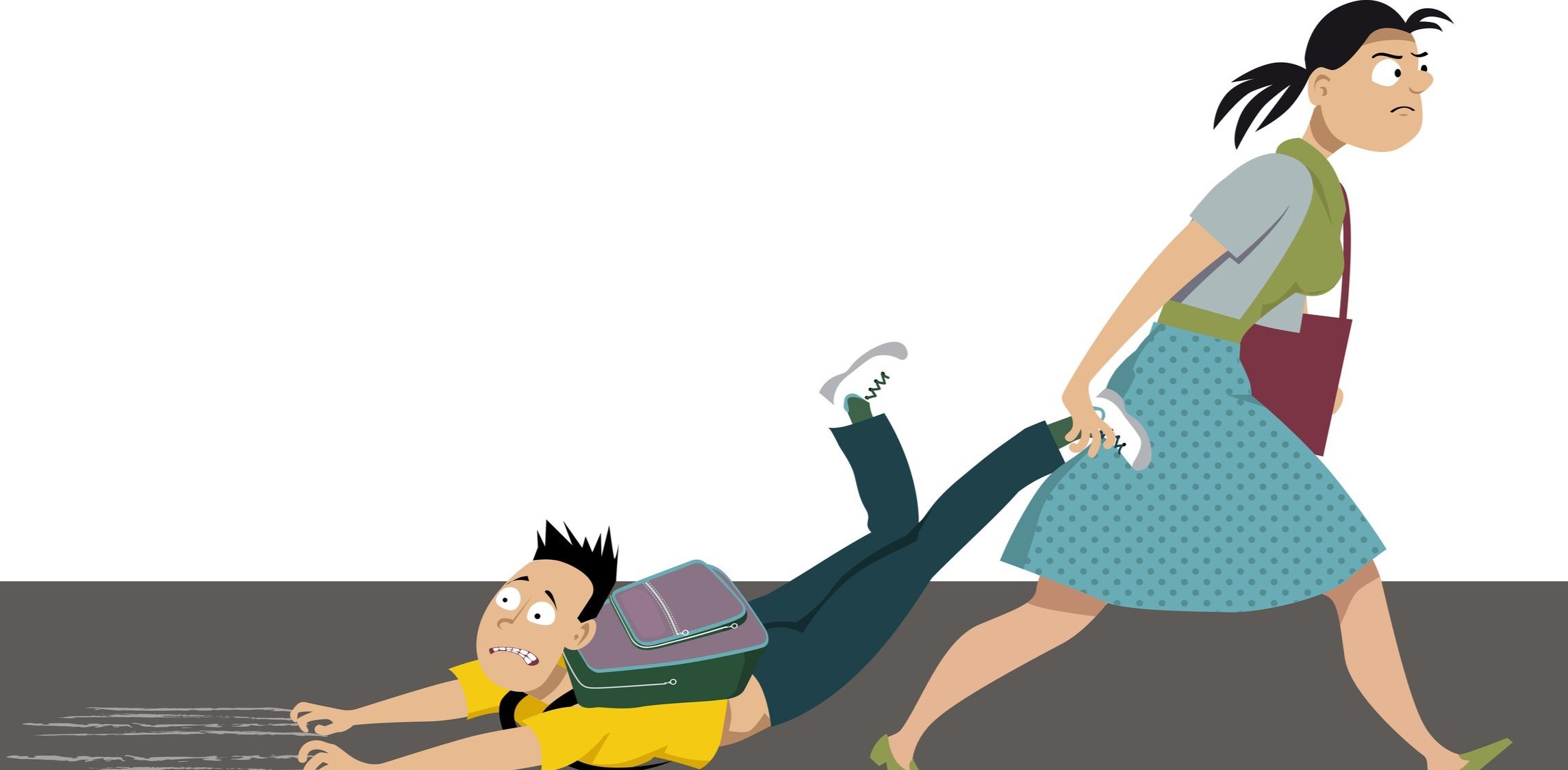
The Trouble With Transitions: Why They Are So Hard For Some Kids And How To Help
My four-year-old was very hesitant when I signed her up for gymnastics class. After a few sessions, she started to join in and now she LOVES it. I can’t get her out of there when class is over. But every week, when it’s time to go back, she fights tooth and nail, insisting she doesn’t want to go. It’s like Groundhog’s Day. I just don’t get it.
This phenomenon is one that many parents I work with find confounding and frustrating, understandably. Where is the learning curve?
As I help parents do the detective work to figure out the root cause of why their kids react this way, in most cases the challenge is making the transition, not their feelings about the activity. Once the child is engaged in the experience, they love it—whether it is school, dance class, jujitsu, art, or going to the playground. As one mom reported just earlier today: “This weekend we told Bodie (5) that we were going to the playground to meet some friends. He melted down, screaming that he wasn’t going; that he hates the playground, and he hates the children we were meeting there. We held firm and got him there, which was really, really hard and uncomfortable. But within minutes he was having the best time playing with the child he had claimed to detest just minutes earlier."
Why are transitions so hard?

When Kids Act Like Dictators
"You have to put all my blocks back exactly the way I had them! You are not allowed to touch my blocks!"
"Stop talking to mommy! I have a question and she needs to listen to me right now!"(Shouting at dad who is in a conversation with mom.)
While kids of all temperaments have been known to act like dictators at times, parents who have HSCs (highly sensitive children) report that their children make these kinds of seemingly outrageous demands on a regular basis. If the demand is not met, their kids can be very angsty and unpleasant. There may be a lot of whining or a full-blown tantrum. Many parents have said they feel like they are "negotiating with terrorists" during these encounters.
These moments are so maddening because:
1) The tone the child takes is mortifying and "obnoxious" and totally unacceptable.
2) What triggers the child seems so minor and irrational, and makes parents feel like their they are raising spoiled brats that they need to "toughen up."
This makes it very challenging for parents who are working so hard to be the empathetic, calm, connected moms and dads they want to be.
A common knee-jerk reaction is to admonish or correct: "You can't talk to us that way! It is disrespectful." This tends to amp kids up further. They are quick to shame in the face of being corrected—which they experience as criticism— propelling them into further dysregulation. When their brains are flooded with overwhelming feelings, they are unable to process or learn any lesson you are trying to teach them. (Here's more on how to teach lessons to kids who can't tolerate being corrected.)
What Your Child Needs

The Lowdown On Limits
Every week I hear from multiple parents who have done great work setting clear limits in a loving way, but are concerned that their limits are wrong or not working because their child continues to protest and not accept the boundary, even after parents repeatedly follow through and don't cave on the limit or get drawn into a protracted power struggle.
The mindshift to make is that the goal is not to get your child to like, agree with, or accept the limit, or even to change his behavior—something you have no control over.
The true purpose of the limit is to stay in charge in the positive way your child needs you to be, and to avoid the pernicious power struggle that is so detrimental and destructive to both kids and parents.
Take the case of Ari, who was coming in and out of his room for hours after lights-out. When his parents, Jen and Arash, stopped trying to coax, reward, bribe or threaten Ari to agree to stay in his room—none of which had been successful—they put a boundary on his door. But Ari continued to scream at the top of his lungs for 5 to 10 minutes every night before falling asleep, even though they stuck to the plan and did not react to his shouting for them. (They did walk by his room periodically to whisper a soothing mantra to assure him they were still there and all was right with the world. More on approaches to setting up loving sleep plans can be found here.) Jen and Arash worried that Ari's continued upset and protests meant that the limit wasn't working or was harmful.
Au contraire. Let's look at all the positive outcomes of this limit:

Positive Parenting Mindshift: Your Child Isn't Misbehaving on Purpose
This blog is the second in a series based on my 2021 book Why is My Child in Charge? A Roadmap to End Power Struggles, Increase Cooperation, and Find More Joy in Parenting Your Young Children.
Through stories of my work with families, I show how making critical mindshifts—seeing children’s behaviors through a new lens —empowers parents to solve their most vexing childrearing challenges, including: tantrums, aggressive behavior, sleep, mealtime battles, and potty learning. Most importantly, it shows you how to get back in the driver's seat--where you belong and where your child needs you to be.
This installment focuses on the mindset that… My child is misbehaving on purpose. He should be able to accept limits and exhibit greater self-control.
Kishan takes his three-year-old daughter, Seema, to the pool several times a week in the summer. Even though Kishan gives Seema a five-minute warning before it’s time to get out of the pool, when time is up, Seema says she hasn’t had enough swimming and needs five more minutes. When Kishan says no, she calls him mean and starts to pout. In a desperate attempt to stave off a tantrum, Kishan relents and gives Seema the extra time, but that changes exactly nothing. Seema still refuses to get out. Kishan tries bribery and threats—she’ll get a treat if she gets out, or she’ll lose a book at bedtime if she doesn’t get out. Nothing works. Eventually, Kishan has to drag Seema out, which is mortifying for him and, he imagines, pretty embarrassing for Seema, too. Kishan starts to dread going to the pool with her and finds every excuse not to go. They spend more time at home doing indoor things. He knows it would be better for his daughter to be outside, using her muscles, learning to swim and making new friends. He feels frustrated and sad for both of them.
If this scenario sounds familiar, you are not alone. Interactions like this play out every day in families with young children: child doesn’t follow a direction, parent tries a range of strategies to get the child to cooperate, child still doesn’t comply, parent loses it and gets punitive, child melts down, parent either feels bad and caves or angrily punishes child with no positive resolution.

Highly Sensitive Children: Is there a sensory piece of the puzzle?
I always thought Samantha was just more ‘intense’ than other children. Her reactions to nearly everything were incredibly strong. She threw massive tantrums at least multiple times a day over things such as having to sit in her car seat or accidentally getting water in her eyes during bath time. People would tell me tantrums were “normal,” but I felt it wasn’t normal to be having such intense tantrums so many times each day. She was incredibly impulsive. She also seemed to both seek physical input (for example, by climbing on others) while also protesting intensely any physical touch that she didn’t like (for example, an adult restraining her from an unsafe situation). She would melt down if someone else did something she wanted to do like flush the toilet, push a button, or turn on the faucet to wash hands, and she often didn’t “recover” for several minutes, even an hour at times. She also had a hard time listening to and following directions, so things like getting her dressed were often very difficult. I felt completely overwhelmed and lost.
I have found in my work that children who are highly sensitive from an emotional standpoint are also likely to be more sensitive to sensory input—to some degree. They experience sights, sounds, tastes, smells and/or textures more intensely. They may become afraid of public bathrooms because the flusher is too jarring and loud. They may reject foods that have strong tastes and smells. They may find bright lights uncomfortable.

Sore Losers: How to help them cope with competition
Leo is the worst sore loser. We can't play any family games because he goes nuts if he doesn't win. Even though he's great at soccer and makes a lot of goals, the second someone blocks one of his attempts to get the ball into the net he starts screaming that it's unfair and storms off the field. It's embarrassing and I worry about how other kids see him and if they are going to want to stop playing with him.
Being a perfectionist and having a very low tolerance for losing go hand-in-hand and makes competitive activities especially stressful for kids who struggle with these issues. To cope and protect themselves from the discomfort and shame that gets triggered when they lose, highly sensitive (HS) kids try to manipulate the game to win (aka "cheat") or they get angry and quit. In a time long ago, before COVID, I was playing Connect Four with five-year-old Lucy on a home visit. She made the first move. When it was my turn, I dropped my piece into the slot next to hers—the obvious move. Lucy immediately got revved up and explained, “No, Ms. Claire, I tell you where you can put your pieces.”
What you can do:

How to Balance the Need for Routines with Helping Kids Be Flexible
What happens when you have done such a good job establishing routines and making sure your child knows what to expect that they fall apart when there is a break in the plan? Or when something unexpected happens? Read on. . .

Just Say “No” to Threats Part 2: What to do when your child is the one using intimidation
Recently, I wrote about avoiding the use of threats to get kids to cooperate or to stop misbehaving. But what about when your child is the one doing the intimidating to get her way, as illustrated in these recent stories parents have shared?
After being told she can’t go ice-skating with a friend because Aunt Jackie is coming over for a visit, Layla (6) announces that she is going to open up her window (in her bedroom on the second floor) and then run out the front door so when her parents can’t find her, they’ll think she fell out of the window.
Marcus (3) threatens not to eat for the rest of the day if his dad won’t give him a snack-bar for breakfast.
Soriah (4) exclaims that she won’t let the babysitter in the house and will “get her dead” if mommy goes out to meet her friends for dinner.
These kinds of provocative proclamations, while not uncommon, are naturally very disturbing to parents who take them at face value and worry that they are raising a sociopath. With this mindset, it is understandable that parents’ knee-jerk reaction is to get harsh and punitive to teach their child a lesson and to shut down these kinds of threats. But this backfires almost every time, as any big parental reaction is a victory for the child and reinforces the power and validity of the irrational proclamation. When efforts to yank their parents’ chain work, the behavior is proven effective.
But children don’t mean what they say when they are in “red zone”. (Even most of us adults can recall a time or two when we said horrible things to those we loved when we were angry or hurt.) In these moments, children are using inflammatory language because they are desperate to get their point across. They also know these alarming threats often get a rise of out of parents, which is their goal.
What to do instead? Ignore the provocation, but don’t ignore your child.

Dealing with Demanding Behavior
I have been talking to a lot of parents recently who are struggling with how to respond to demanding, dictatorial behavior. Think:
"Get me orange juice!"
"Put my shoes on!"
“Bring me my blanket!"
Most parents find demands like this from their kids infuriating, understandably. Their knee-jerk reaction goes something like this: "You can't talk to me that way! I won't get you anything when you use that tone." This seems totally logical, but it often backfires. When we respond with a negative (and often revved-up) tone, it tends to amplify children's negativity and make them more of a "fascist dictator" as many a parent has been known to describe their child.
As counterintuitive as it may seem, I find the most effective response is to take the following approach:

I Don’t Like the Choices You’re Choicing Me! How to Set Clear, Enforceable Limits…with Love
Marta has told her 3-year-old, Ruby, to pick up her toys 5 times in the past 10 minutes. Marta is getting increasingly agitated and annoyed, and finally shouts at Ruby that if she doesn’t put all the toys away, Marta will throw them in the garbage. When Ruby continues to ignore her mother’s request, Marta pulls out a plastic trash bag and starts to fill it with Ruby’s toys. Ruby becomes hysterical and Marta feels horrible and ashamed. She takes the toys back out of the bag and comforts Ruby. Marta ultimately cleans the toys up after Ruby has gone to bed.
Every week I am in the homes of families with young children who are struggling with these kinds of scenarios. They are frustrated and angry that their children won’t cooperate, and that they are “driving the car”—taking the parents for a ride. Further, parents feel ashamed when they lose it, when they say harsh things to their children in the heat of the moment and make threats they have no intention of following through on (i.e., to never give them the iPad or take them to the playground again). Ultimately, these parents are depleted and sad, because by the end of the day all they have done is yelled and dealt with ugly power struggles, leaving little room for the pleasures of parenthood.
As I have watched these dynamics unfold on one home visit after another, it has become clear that one key factor at the root of the problem is that the limits and expectations parents set are often dependent on the child’s cooperation—to clean up their toys, get into their PJs, or climb happily into the car seat. The problem is that you can’t actually physically make your child do these things. And any time you are waiting for your child to follow a direction or trying to convince her to cooperate, she is in control. You can demand repeatedly that she not throw a ball in the house or to stay in her room after lights-out, but unless you have a plan for how you are going to follow through on the limit you are trying to set, your child is in the driver’s seat and she knows it. This is not good for her or for you. So, as you go about setting limits, keep in mind that a limit is only as effective as your ability to implement it.
The following are key elements to a positive and effective approach to setting limits:

“I Said I Want the Red Bowl!” Responding to Toddlers’ Irrational Behavior
Claire Lerner, LCSW
Amelia, told that she can’t have a fifth book before bedtime, shouts: “You are the meanest mommy! You are not invited to my birthday party!” Derek, when offered a choice between carrots and cheese, not ice cream, before dinner announces: “I don’t like the choices you are choicing me!” Alex hurls a bowl of his favorite cereal off the table and screams, “I said the red bowl, not the blue bowl!” If any of these exclamations sounds familiar, you are not alone. Welcome to what can feel like the Wild West of toddlerhood.
But seen through the eyes of the child, and through the lens of development, these behaviors, while maddening, are utterly normal, and signal important milestones are being achieved. Further, these incidents don’t have to be dreaded, as they are opportunities to teach children to manage their emotions, learn to cope with frustration and disappointment, and find ways to feel in control of their ever-expanding worlds in prosocial, acceptable ways.
Getting clear on expectations is critical because the meaning we assign to a child’s behavior influences how we manage our own emotions and reactions to the behavior at hand. If we see the behavior as manipulative or purposely designed to drive us crazy, then we are much more likely to react in angry or harsh ways that escalate instead of calm our child. If, instead, we see these behaviors in the context of normal development, then we can approach our children with empathy and be more effective in teaching good coping skills.
Here are some important factors that influence young children’s behavior that are helpful to keep in mind when dealing with challenging behaviors: