
Lerner Child Development Blog
Blogs By Categories
- ADHD
- All Most Popular
- All Most Popular Blogs
- Anxiety
- Big Reactors
- Blogs
- Building Resilience
- Challenging behaviors
- Cooperation
- Distress Tolerance
- Emotional Regulation
- Food Challenges
- Highly Sensitive Children
- Limit-Setting With Love
- Low Frustration Tolerance
- Mealtime
- Neurodiversity
- No Power Struggles
- Parental Self Awareness
- Parental Self Regulation
- Physical Aggression
- Positive Discipline
- Potty Learning
- Regression
- School Related Issues
- School challenges
- Separation and Divorce
- Sibling Issues
- Sleep
- Social challenges
- Social emotional development
- challenging behaviors
- explosive behavior
- food
- lying
- masking
- mealtime
- parenting self-awareness
- positive parenting
- separation anxiety
- sleep
- social emotional development
- stress
- victim mindset

Eight Strategies for Working at Home While Caring for Kids
The pandemic led to many seismic shifts in our world, including the advent of parents working at home. As if parenting isn’t stressful enough, the complexity of managing work/life balance became much more challenging. This blog provides guidance on how to set and enforce healthy expectations and boundaries when you are working at home.

Regression: Why children take steps backwards in their development and what you can do
Madison used to be a great sleeper. Over the past few weeks, as the coronavirus lockdown has persisted, bedtime has deteriorated. It started with Madison insisting that I stay with her until she falls asleep. Now she insists on sleeping in our bed all night. –Father of a four-year-old
Jackson had been fully potty trained and was a “big boy” in so many ways. Since his little brother was born, he has started to have a lot of accidents. He is demanding a bottle and wants to be carried 24/7. This is driving us crazy. We don’t need two babies in this household! —Mom of a three-year-old
Kids regressing—moving backwards in their development—is a common phenomenon. It is usually in reaction to a stressor: a move, a new baby in the family, a change in schools or caregivers, or…a global pandemic, to name a few. Any change or disruption in children’s daily routines is stressful.
When we, children and adults alike, experience shifts in our worlds (especially when they are unexpected or seismic, like COVID), our psychic energy gets diverted from higher level brain functions to just trying to cope day to day. (Few people I know would say they are at the top of their game right now. Just like many of us are having a harder time managing everyday tasks and challenges, so are our kids.) This can result in more challenging behaviors and regression to less mature levels of functioning. When a child’s system is stressed, she may get frustrated more easily, become more clingy, have more potty accidents, experience sleep disruption, or, have a change in her eating patterns. Keep in mind that highly sensitive (HS) children are more prone to regression as they are more vulnerable and reactive to changes in their world.
That’s not to say that all stress is harmful to kids. For example, starting preschool is a major shift. Most children go through a period of discomfort as they learn to adapt to this new experience—managing the separation from parents/caregivers, figuring out the rules of the classroom and how to get along with peers. This is positive stress because it leads to growth and the development of new skills. But during this adaptation process, some regression is to be expected. In the preschools where I consult, there are always some children who in the first month of school won’t eat snack or use the toilet, and may not do a lot of talking or interacting with their peers or teachers. Once they adapt, they feel comfortable and their stress is reduced, they have access to all of their skills—their full range of functioning—and thrive.
Also keep in mind that highly sensitive (HS) children are more prone to regression as they are more vulnerable and reactive to changes in their world.
RESPONDING TO REGRESSION: WHAT NOT TO DO
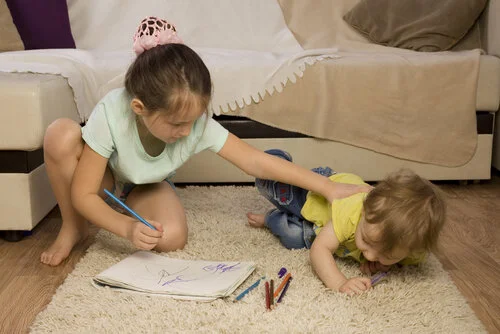
Why Can't You All Just Get Along?
“Haha—you lost!”
“Stop singing that stupid song. You’re hurting my ears!”
“YOU CANNOT PLAY THIS GAME. YOU DO NOT KNOW HOW TO PLAY!”
The sibling relationship is about as complex as it gets. Talk about the confluence of emotions that run the gamut from the extremes of love and hate. The natural conflict that arises as siblings navigate their relationship ranks as one of the most vexing challenges for parents, often sending them into reactive-mode which tends to exacerbate, not eliminate, sibling squabbles.
Since every family dynamic is different, there is no prescriptive approach to effectively addressing sibling rivalry. Instead, I offer some key guiding principles to help you avoid common pitfalls, as well as some actionable strategies for responding supportively and effectively when your kids are causing chaos, that you can tailor to your unique situation.
GUIDING PRINCIPLES

How to Support Kids Spiraling Out of Control
Janelle starts reading a bedtime book to her three-year-old, Sam. One page in, he starts screaming that she isn’t reading the book the right way and insists that daddy (Brent) take over. This flip-flopping goes on for several more rounds until both Janelle and Brent are at their wits end and Sam wears himself out sobbing and falls asleep.
Lucy (4) asks for toast for breakfast. Bernard, one of her dads, presents it to her; but, uh-oh, he has cut it on the diagonal when she wanted it halved down the middle! Lucy insists that he must make a new piece of toast. Bernard sighs heavily—they’ve been around this block before—and looks at his husband, Josh, with that “what to do?” hunch of the shoulders. They know Lucy is having a hard time these days with all the changes in her world. So, they decide they will ease her stress by meeting her demand. Josh pops another piece of bread into the toaster. When he hands it to her, Lucy announces that what she really wants is a scrambled egg. Josh gets visibly annoyed with Lucy—telling her to make up her mind. She starts to pout and tells Josh to stop yelling at her. Josh feels bad for losing it with her and proceeds to whip up an egg. Spoiler alert: Lucy proclaims that the egg is too yellow, and the crazy-making cycle continues.
When children feel out of control on the inside, they act out of control on the outside, which results in situations like those described above. And, those “orchids”—the kids who are more sensitive and reactive by nature—are even more likely to struggle during this time of major change.
How do you respond to children who are spiraling out of control and getting themselves into complete tizzies, driving themselves, and everyone around them, mad?

How to Balance Working From Home While Caring for Kids
As if being a working parent wasn’t stressful enough, what do you do when suddenly you are expected to work at home and take care of your kids at the same time? If you are in this predicament, here are some ideas for how to manage the seemingly unmanageable. Of course, you will need to adapt and apply these based on the age of your child and your unique situation.

How to Balance the Need for Routines with Helping Kids Be Flexible
What happens when you have done such a good job establishing routines and making sure your child knows what to expect that they fall apart when there is a break in the plan? Or when something unexpected happens? Read on. . .

Happy Children Aren’t Always Happy: Eight Pivotal Parenting Pitfalls and How to Prevent Them
The obstacle to parents being the loving limit setters their children need (but don’t want) them to be is often the false notion that happy children are always happy; that it is your job to keep your child happy. In fact, it is working through the frustration and disappointment of not always getting what they want when they want it that builds resilience and makes children happy. This blog addresses how to do just that.

Safe Space Breaks: When Giving Your Child (And Yourself!) A Break Can Be Helpful, Not Harmful
One of the most challenging situations families of big reactors face is what to do when their children are so out of control that they are destructive. They are "going to a category five in a nanosecond" and there is no calming them once they are triggered. Their meltdowns are frequent and intense. In the heat of these "red-zone" moments—when their children are hurling objects, kicking, hitting, biting, scratching and spitting—these parents are pushed to their emotional, and physical, limit. They instinctively know that a break is necessary—for themselves and their children.
The problem is that most have spent a fair amount of time on social media and have been barraged with the message that time-out is not developmentally appropriate and can be detrimental to their child; that it is negating children's feelings and tantamount to traumatizing them by abandoning them when they are in distress. What loving parent would do something that could be so harmful to their child?
This leaves these parents in despair, feeling like their hands are tied, totally helpless. It is an awful feeling that is not good for them or their kids.
The frequency of these stories led to my decision to start incorporating home visits into my practice so I could observe first-hand how these encounters unfold and provide more relevant and targeted support to parents—that meets them in their realities. What I saw was that when emotions (and cortisol levels in the brain) are sky-high, a break for both parent and child can be a healthier approach than the tense, often aggressive, back-and-forth (physical and emotional) that ensues in red-zone moments when parents are trying to physically restrain children and losing control themselves. While remaining with their child in these moments feels like the more loving thing to do, this dynamic is much more harmful to children than providing them (and their parents!) some space in a safe and loving way. What's the parent of a big reactor to do?
So, in this blog I am revisiting this whole controversy about time-out because it continues to vex many families who come to see me. And, because I want to spread the very important word that two highly respected colleagues have recently reviewed the actual research on time-out and both have concluded that not only isn't it harmful, but can be a helpful, positive parenting strategy. It's all abut how it is implemented.
The Controversy Around Time-Out
There is broad agreement that the use of time-out as punishment for “misbehavior” is both developmentally inappropriate and ineffective. A robust body of research clearly shows that the part of the brain that controls the ability to think about and manage feelings and actions is not well-developed in young children. They are driven by their emotions and impulses. They are not misbehaving on purpose, so they don’t learn anything from time-outs. Further, punitive approaches tend to increase challenging behaviors. They exacerbate the distress children are already experiencing as they struggle to cope with life’s myriad frustrations and disappointments. They need our empathy and support, not anger and rejection.
The problem is that now time-out has become a catchall. Any type of break a child might need is seen as punitive and detrimental to children. The antidote to time-out has become time-in, which entails staying with the child throughout the meltdown, no matter what. Parents act as “co-regulators”, providing the support young children need to soothe themselves given that they have very limited ability to self-regulate.
This makes all the sense in the world, in theory. But for many families, the reality is that their presence in these moments is not calming or regulating for their child who is so out of control that they cannot accept comfort. The more these moms and dads try to calm their kids, the more out of control they get. In these situations, time-in is not helping soothe their child’s stress response. Being in the room with their child is a stimulant, even when parents are staying calm and quiet. They become an available target for continued aggressive behavior, keeping their child revved up and reactive.
Not to mention that parents are also human, and as hard as we may work on controlling our emotions, there are times when children are so out-of-control and destructive that the only way to cool things down is to take a break from the intensity of the moment.
Consequently, I have come to believe that it is a disservice to parents to tell them that the only acceptable option when their child is spiraling out of control is time-in. They already feel like failures for having a child who can get so out-of-control and destructive. When time-ins only extend and exacerbate these red-zone moments, parents despair that they have no tool that enables them to maintain some sense of control over their child’s behavior. They are physically and emotionally “burnt-out,” as one parent recently put it, from all the knock-down, drag-out battles they experience—sometimes on a daily basis. And, sadly, these parents spend a lot of time feeling angry at their children for making them feel so out of control.
The Research On Time-Out Does Not Show Harmful Effects and Confirms It Can Be a Helpful, Loving Strategy
Science journalist, Melinda Wenner Moyer recently did a review of all the research on time-outs and reports: “In the parenting advice world, the big concerns about time-outs are that they are emotionally damaging and that they erode the quality of the parent-child relationship. Yet I couldn’t find evidence to suggest they do either of these things, and found plenty of research suggesting the opposite." She continues: "Clinical psychologists evaluated the vast published research on time-outs, concluding that ‘time-out represents a safe, effective form of discipline which, in the context of a larger environment dominated by positivity, consistency, and predictability, has been shown across hundreds of research studies to be beneficial to the overall emotional and developmental functioning of young children.'"
Psychologist Cara Goodwin did a deep-dive into the genesis of Time-Out, and it's impact on parent-child attachment (I assume because parents are bombarded with claims on social media about time-out eroding a secure attachment.) She found that time-out has no negative impact on attachment, and that "Temporary and predictable separations with positive reunions are an important part of secure attachment." It's all about how parents provide this break. I strongly recommend you read her excellent article, highlighted above.
How to Implement the "Safe-Space Break" in a Loving and Supportive Way
The breaks I suggest parents give themselves and their children in these most challenging moments are not punitive but loving and supportive. I don’t call them “time-out” because this term has become synonymous with punishment. I call them “safe-space breaks." Breaks are not inherently or necessarily harmful to young children: it’s all in the way they are executed. When parents approach the break calmly and lovingly—not punitively ("Go to your room right now!”)—this tool can be caring, not callous. It creates the space parents and children need to prevent further escalation, and to come back together to solve the problem when they are both calm.
Let your child know what the plan will be when they are in the red-zone. In a quiet moment (not during a tantrum), acknowledge that meltdowns will happen. Everyone experiences times when they are so upset that they lose control of their minds and bodies. Explain to your child that when they are in that state, your job is to be their helper. You will always first try to help them get calm by using a range of tools you come up with together, such as giving them a bear hug, or taking deep belly breaths.
But in situations in which they are having a hard time controlling their body, you will take them to their safe space. Make the focus keeping them safe, not that you are protecting other people from them. (If you make the focus on how they are being harmful to others, it is likely to be more triggering to them and result in further dysregulation.) Once they are calm, you can talk about the incident—depending on their age—and help them begin to understand how their behavior impacts both themselves and others.
Show them that you have a safe-space break, too. This could simply be your room. Place some calming tools in there—like stress balls, exercise bands you can snap, etc.—and explain to your child that when you are getting agitated, you go into your safe space and use these objects, or strategies like taking deep breaths, to get yourself calm. Then, when you are calm, you are better able to help solve whatever problem is at hand. This is a very powerful model for self-regulation, reinforces that the safe space is not punishment but a tool for calming that everyone needs, and shows them that they are not alone. A dad recently reported that when he modeled this in the heat of a moment with his almost 4-year-old, his son responded by going into his room and looking at books to calm himself.
Be sure the safe space has a boundary to prevent your child from exiting on their own. For children who will not stay in the safe space and keep running out before they are back in control, I find it essential to provide a boundary. When children can exit the safe space freely, parents lose control over the situation which tends to only further fuel the frenzy. Boundaries are good for kids. They keep them safe and secure. I recommend using a door monkey which keeps the door wedged open a few inches—not enough for a child to squeeze out. This way you don’t have to close or lock doors. Preview how door monkey works so your child knows exactly what to expect: “This is our friend Mr. Door Helper. He keeps you secure in your safe space until your body is calm.” If the door monkey doesn't work in your home (ie if you live in an old row house), using a door knob cover or reversing the lock on the door can work well.
A child’s bedroom can serve as the safe space since it is not being used as punishment but as a loving, calming place.
Once your child is safely in the space, you can sit on the other side of the door and say a calming mantra or just be a quiet presence. Just knowing you are there to weather the storm is loving and supportive to your child, even if they are not making you feel like you are being loving and supportive.
In situations where you don’t feel you can get your child into the safe space, (i.e., if you have an older child who is too big for you to carry to the space) an alternative is to secure yourself in a safe space and calmly tell your child: “I am going to my safe space. When you are back in control of your body I will come out and we can work on solving the problem.”
Include your child in designing the space. First, be sure to child-proof the space. Make sure there are no dangerous objects they can gain access to. Remove anything they can climb on such as stools or chairs. Brainstorm together what they can do in their safe space. Help them choose from a range of acceptable items that can be included, such as: stuffed animals, squishy balls, cozy pillows, and books. Putting a kids’ tent in the space can be very effective as it feels snuggly and comforting to children, especially when they are unraveling. Creating a warm, friendly space communicates to your child that it is not for punishment—it’s a loving space. (Still, don't expect your child to thank you for putting them in the break space. Remember, just because a child doesn't like a limit doesn't mean it's not good for them.)
Stay as calm as possible when moving your child to the break space. If your child is not able or willing to go to the break space on their own, you may need to carry them there. Even as you hold them at arm’s length to avoid their kicking, hitting or biting, try to stay calm and keep language to a minimum. Remember, kids can’t process more input when they are in the red-zone. Their brains are flooded with emotion and they can't think rationally. Whisper a calming statement: “You’re really upset and are having a hard time controlling your body. I am going to be a helper and take you to your safe space for a break. When you are calm we can get back to playing.”
You can stay on the other side of the door and say a calming mantra, like: “I know, this is a tough moment. I am here.”
Options for ending the break. Some parents choose to end the break when their child is calm. Another option is to set a timer for three to five minutes, then check in. At this point, your child may still be upset, but if they are no longer out of control and are able to accept being comforted, you can help them move on. It can also be helpful to tell your child that when they count to 10, you will know their body is calm. Giving them a job—something to focus their attention—can be organizing and help them regulate.
Be sure to have appropriate expectations for what the break will accomplish. Young children do not yet have the ability to reflect on their actions and behavior on their own, without help from a caring adult. This means that the goal of taking a break is not self-reflection: “Gee, I wonder why I let my emotions get the best of me—I really shouldn’t have scratched and kicked daddy when he turned the TV off” is beyond toddlers and even preschoolers (not to mention many adults!) The goal is to provide a quiet place where your child can move from a state of high agitation and upset to calm. The break offers the space for both parent and child to regroup. No learning takes place when children are in an agitated, emotionally flooded state.
Breakdowns are evidence that children are experiencing overwhelming stress they can’t manage. When your child is being harmful and you cannot control them, or when they are so out of control that they cannot accept and benefit from your attempts to comfort them, a short break from interaction can help them (and you!) cool down. In the context of a loving, strong parent-child relationship, giving your child and yourself this space can be helpful, not harmful.
Related articles:
How To Be a “Gentle” Parent With a Big Reactor
How to deal with public meltdowns Managing physical aggressionWhen limit-setting gets physicalStop working so hard to calm your child

Why Punishment Doesn't Stop Aggressive Behavior
Few things are more vexing than when children are physically aggressive: hitting, kicking, pushing, biting, pinching. Many parents I work with worry that this kind of behavior signals a lack of empathy. One dad recently wondered about something that is perplexing to many parents: "How could we—such loving, peaceful people—have created a kid who can be so hurtful?”
At the same time, parents fear the consequences for their child: Will she be seen as a bully? Will other children not want to play with him? Will she get kicked out of preschool? And for themselves: Will I be alienated from the other parents who judge me because of my child’s behavior?
These are all very natural concerns which understandably trigger intense reactions. In an effort to eliminate these aggressive behaviors, most parents become harsh and punitive. They shame: “What is wrong with you? Why would you want to hurt your friend?” They use threats and punishment: “No TV time for the rest of the week if you hit again!” Or, instill fear: “No one will ever want to play with you if you hurt them.”
The problem with these tactics is that while they may seem logical from an adult perspective—that they should motivate a child to stop the behaviors—they often backfire for several reasons:

Just Say “No” to Threats Part 2: What to do when your child is the one using intimidation
Recently, I wrote about avoiding the use of threats to get kids to cooperate or to stop misbehaving. But what about when your child is the one doing the intimidating to get her way, as illustrated in these recent stories parents have shared?
After being told she can’t go ice-skating with a friend because Aunt Jackie is coming over for a visit, Layla (6) announces that she is going to open up her window (in her bedroom on the second floor) and then run out the front door so when her parents can’t find her, they’ll think she fell out of the window.
Marcus (3) threatens not to eat for the rest of the day if his dad won’t give him a snack-bar for breakfast.
Soriah (4) exclaims that she won’t let the babysitter in the house and will “get her dead” if mommy goes out to meet her friends for dinner.
These kinds of provocative proclamations, while not uncommon, are naturally very disturbing to parents who take them at face value and worry that they are raising a sociopath. With this mindset, it is understandable that parents’ knee-jerk reaction is to get harsh and punitive to teach their child a lesson and to shut down these kinds of threats. But this backfires almost every time, as any big parental reaction is a victory for the child and reinforces the power and validity of the irrational proclamation. When efforts to yank their parents’ chain work, the behavior is proven effective.
But children don’t mean what they say when they are in “red zone”. (Even most of us adults can recall a time or two when we said horrible things to those we loved when we were angry or hurt.) In these moments, children are using inflammatory language because they are desperate to get their point across. They also know these alarming threats often get a rise of out of parents, which is their goal.
What to do instead? Ignore the provocation, but don’t ignore your child.
Just Say "NO!" to Threats
“If you don’t stay in your room and get to sleep, I am going to put a gate up!”
“If you don't put all these toys away, I am throwing them in the trash."
Most parents have resorted to threats like these in a desperate attempt to get their kids to cooperate. But this tactic often backfires because children pick up on the negativity and react to it. It sends the message to your child that you are already anticipating that she isn’t going to comply and that you are in for a fight. This puts kids in oppositional, power-struggle mode, especially children who are more defiant by nature. Negativity and threats tend to amplify their resistance and they just dig in their heels more firmly. (Not to mention that most of the time parents have no intention of following through on the threat and the child knows it.)
What you can do

Dealing with Demanding Behavior
I have been talking to a lot of parents recently who are struggling with how to respond to demanding, dictatorial behavior. Think:
"Get me orange juice!"
"Put my shoes on!"
“Bring me my blanket!"
Most parents find demands like this from their kids infuriating, understandably. Their knee-jerk reaction goes something like this: "You can't talk to me that way! I won't get you anything when you use that tone." This seems totally logical, but it often backfires. When we respond with a negative (and often revved-up) tone, it tends to amplify children's negativity and make them more of a "fascist dictator" as many a parent has been known to describe their child.
As counterintuitive as it may seem, I find the most effective response is to take the following approach:

Limits are Only as Effective as Your Ability to Implement Them
Adam and Brian are entrenched in breakfast battles with their 3-year-old, Sadie, who lollygags and gets up and down from the table for a seemingly endless array of urgent tasks she insists must be undertaken. She keeps going back to her room to make sure her teddy’s blanket is still on securely. Or, she looks for the toy she wants to bring to school that day to put in her backpack. Her dads vacillate between trying to convince her to eat—telling her she will be hungry at school—and making threats such as no dessert after dinner if she doesn’t stay at the table. None of these tactics motivates Sadie to sit and eat. When they announce that it’s time to leave for school after the more-than-adequate 20 minutes they have allotted for breakfast, Sadie has taken maybe 3 small bites of her toast. She starts shouting: “I haven’t had time to eat and will starve!” Exasperated but worried that she will be hungry at school, Adam and Brian give her five more minutes which turns into 10 and then 15. They finally, angrily pick her up and get her into her car seat. With Sadie in hysterics, they scold her for making everyone late and lecture her all the way to school about how it is her fault if she doesn’t eat. Everyone is miserable.
I see this dynamic play out in home after home: parents unsuccessful at getting their kids to cooperate—be it to eat, sleep, put toys away—by trying to convince them to comply using logic (you’ll be hungry!), threats and bribery. The problem with these tactics is that they all put the child in the driver’s seat. Whenever parents are in the position of trying to convince a child to comply with a direction and are waiting for her to agree to the expectation they have set, the child holds all the cards. This naturally makes parents feel out of control which leads to reactive and harsh responses that only intensify the struggle and reduce a parent’s ability to be effective.
The key is for parents to make a critical mindset shift which is to recognize that you have no control over your child. He’s a human being and you can’t make him do anything, including eat, pee in the potty, clean up his toys, or go to sleep. The only person you control is you.
When It’s Not Okay to Say, “Okay?”
I have to give my mom credit for this insight. On a visit when my son was three, she pointed out that every time I gave him a direction, I ended it with “Okay?” She wondered why I would ask a question when I was not intending to give my son a choice (Sam, time to leave the playground, okay?) and noted that this might be confusing to him. Once I was aware of this dynamic, I realized that it had become a totally unconscious, reflexive response that I used constantly.Sam, time for bath, okay? Sam, time to get in the car, okay?I also began to notice that this was a pervasive phenomenon in every family I worked with. Twenty-five years later, as I visit home after home, I can confidently report that nothing has changed. We all fall prey to this pitfall. And it’s a problematic one, because it is confusing to children: they hear that they are being given a choice even though this is not their parents’ intention. When children don’t comply, it results in a lot of frustration and anger. I was at a home visit recently during which a mom kept asking her 2-year-old to, “Please take your feet off the kitchen table, okay?” After several requests the toddler turned to her mom and simply said, “No, I like them on the table.”
While it seems simple to just kick this unhelpful habit, that’s not how we operate as parents. These knee-jerk reactions tend to be pretty persistent. The only way most of us are able to make a change is to become conscious of what is driving us to act as we do—what the trigger is. Otherwise, the impulse wins out over what we know is “right” almost every time.
For me, and most parents I have talked with about this phenomenon, the root of our reaction lies in a discomfort with giving directions. It feels dictatorial and authoritarian, which is inconsistent with who we are and who we want to be as parents. We know how important it is to nurture children’s sense of agency and independence. Telling them what to do feels contrary to that goal.
The mental shift we need to make is seeing that children thrive when they know exactly what is expected of them. The same is true for adults. We feel less anxious, more in control and better able to complete tasks at work when our boss is clear about what the expectations are. This is precisely why children tend to behave better at school than at home: good teachers have no problem giving directions, and children love them all the same. Making marching orders crystal clear gives kids the information they need to make good choices. They clean up after snack so they can move on to an activity; they put the sandbox toys away so they can earn the privilege of playing with them the next time they go to the playground.
What to do?
Pause and Problem-solve--A Handy Tool for Helping Children Get Calm and Cope
On a recent visit to a preschool, I was working with the teachers to come up with strategies to help the children learn to become good problem-solvers. The greatest obstacle to this, the teachers noted, was helping the children remain calm when facing a challenge so they can persevere to solve a problem. They find this is especially difficult for the “big reactors” who tend to go from 0-60 in the blink of an eye. Common tactics, such as deep belly breathing, weren't working as well as the teachers would have liked. They couldn’t get the kids calm enough to even use this soothing tool.
Since I have had some success with the use of cues or mantras for children—a phrase you use repeatedly to throw a monkey-wrench into a detrimental dynamic—I decided to try a new one out with a class of four-year-olds. It is designed to help build self-regulation. I call it Pause-and-Problem-Solve, and it has proven to be quite powerful for helping children regroup in a positive way when a breakdown is brewing. In this newsletter, I share how you might use this tool to encourage your children to become good problem-solvers. Here are the key steps:

Fair is NOT Equal
A spate of parents I’ve seen recently have expressed a lot of frustration over the fact that every time they say “no” to their kids, they are accused of being unfair. This is a major trigger for parents, sending them into reactive mode. They either start to defend their decisions to their children or they give in. Both responses validate that their child’s assessment of the situation is accurate or reasonable, when in most cases it is decidedly not. For example: Jonah, 6, who protests that it’s not fair that his older brother, Sam (age 9), gets to stay up later; Stella, 4, who explains that it’s not fair that she has to sleep alone when her parents get to sleep together; and, Lucca, 5, who insists that it’s not fair that he has to share the Magnatiles with his brother who isn’t as serious about building as Lucca.
Just because in our logical minds these protestations can seem irrational doesn’t mean that your child doesn’t actually feel an inequity is taking place. In some cases, it is just a strategy to get you to change your mind and give in to something your child wants. Kids are clever and will use whatever tactics work to reach their goal. But in many cases, on the face of it, the rule does seem unfair to children—that a sibling gets to stay up later or that parents get to sleep together but the child has to sleep alone.
And sometimes there are contextual factors that we need to be sensitive to. For example, I recently met with parents who have a 6-year-old, Liam, who constantly feels like a victim. As we unpacked how he may have developed this sense of himself, it turns out that when he was a toddler, his older brother was diagnosed with a serious illness and went through three years of intensive treatment. The parents had a large group of friends and family to help. But Liam likely sensed that his parents were distracted (understandably) and consequently started building a narrative that his needs were not as important as those of his older brother. Add to that the fact that Liam now has two younger siblings, including a new baby, amplifying his worry about whether he will get the attention he wants.
It is important to be sensitive to the underlying forces that influence your children’s behavior and the lens through which they filter their experiences. Even if your kids have not gone through a family trauma like this, many experience tough periods when they are trying to make sense of their place in the family. Temperament is also a factor: children who are inflexible by nature tend to develop very fixed ideas about how things should be and thus have a very hard time when things don’t go according to their desire or plan. This often results in the refrain: “IT’S NOT FAIR!”
The goal is to help children see that not getting everything they want is about healthy and developmentally appropriate limits, not about love or favoritism. Liam’s parents want him to create a new narrative that is not one of “I am a victim, always being deprived”, but one that sounds more like, “When I can’t have everything the way I want it, and my parents set limits, it doesn’t mean I am not loved or valued.” Mature as this outlook may seem, over time, children can and do internalize this very important concept.
Below is a roadmap for responding to protestations of "it’s unfair!" that enables you to be empathetic while maintaining the limits that you feel are important for your child:

Securing Sleep: Key Principles for Helping Your Child Become a Good Sleeper
Nine-month-old Lilah, previously a great sleeper, has started to protest when her mom puts her down to sleep. She wakes up multiple times at night. She won’t fall back to sleep unless she gets a bottle that she scarfs down.
Three-year-old Amir insists on an endless litany of demands at bedtime—2, then 3, then 4 more books, placing his cars in a specific order on his shelf, getting his blankets on “just right”. Even when his parents acquiesce, it’s never enough. He still flips out when they say they are leaving and it’s time for him to go to sleep. When they finally put a monkey lock on Amir’s door to keep him from leaving his room after lights-out, he gets them in the jugular by shouting things like: “It’s illegal to ignore your child!”
Sleep challenges come in all shapes and sizes. And, like most childrearing challenges, a one-size-fits-all approach to help children become good sleepers does not exist. Every child and family is different. The underlying cause of the trouble can vary significantly from one scenario to another. One child struggles with separation anxiety; another tests limits; another doesn’t know how to fall asleep on his own. That’s why general prescriptions don’t work. In fact, they can lead to more frustration for parents when the suggested plan does not feel comfortable for them or doesn’t work for their child. Instead, what I have found most useful is to provide parents with a set of guiding principles to develop their own path to help their child (and themselves!) get a good night’s sleep. These are not solutions to specific sleep challenges, but rather overarching strategies and mindset shifts that empower you to come up with an approach that meets your child’s and family’s needs.
Guiding Principles

Having Trouble Understanding Your Child’s Challenging Behaviors? His Sensory Processing System May Provide Important Clues
“I always thought Samantha was just more ‘intense’ than other children. Her reactions to nearly everything were incredibly strong. She threw massive tantrums at least 5-10 times per day over things such as having to sit in her car seat or accidentally getting water in her eyes during bath time. People would tell me tantrums were “normal,” but I felt it wasn’t normal to be having such intense tantrums so many times each day. She was incredibly impulsive and constantly reached out to touch interesting things she saw, regardless of the appropriateness (such as clothing on someone’s body) or the danger (such as a burning candle). She also seemed to both seek physical input (for example, by climbing on others) while also protesting intensely to any physical touch that she didn’t like (for example, an adult restraining her from an unsafe situation). She would melt down if someone else did something she wanted to do like flush the toilet, push a button, or turn on the faucet to wash hands, and she often didn’t “recover” for several minutes, even an hour at times. She also had a hard time listening to and following directions, so things like getting her dressed were often very difficult. I felt completely overwhelmed and lost.”
— Samantha's mom
About 10 years ago, I was feeling increasingly frustrated with the limited progress many children I was working with—such as two-year-old, Samantha—were making using the typical tools of my trade. Trained as a clinical social worker, my focus was on helping parents understand their children’s emotions and providing them with strategies to help their children learn to manage their feelings so they could behave in constructive, “pro-social” ways. No matter how tuned in, loving, and empathetic parents were, and how clearly and consistently they were setting limits and boundaries, their children continued to struggle with typical challenging behaviors such as: biting/hitting/kicking, defiance, extreme fearfulness/anxiety, impulsivity, or an overall lack of self-regulation.
Around this time, a friend was telling me about problems she was having with her then 3-year-old, “Ruben”. He was very impulsive, aggressive, defiant, and wasn’t tuning in to others—all behaviors very typical of the kids I was having the hardest time helping. She told me that after trying many different failed behavioral interventions, they were referred to an occupational therapist (OT) who identified underlying sensory processing challenges that were at the root of many of the problematic behaviors Ruben was exhibiting. Further, she explained how the therapy Ruben was doing with the OT was yielding very positive results for the first time. I am embarrassed to admit that at that time I was mostly ignorant about OT for kids. I thought of it as an intervention for adults with carpal tunnel syndrome or who had been injured on the job. What could the “occupation” of a child possibly be? So, I asked my friend for permission to observe a few sessions of her son’s OT.
That experience proved to be a watershed moment: I saw first-hand how many challenging behaviors children exhibit are rooted in problems in their sensory processing systems and that this was a critical piece of the puzzle that I was missing as I tried to make sense of the meaning of children’s behaviors. For example, some of Ruben’s challenges were the result of a low threshold for tactile input. When people got too close to him, he pushed them away—by biting, hitting, kicking—to protect himself. Through targeted activities, the OT incrementally exposed Ruben to tactile experiences to help his system better detect, regulate, and interpret these sensations and respond to them more appropriately. In effect, OTs help children do their most important “jobs”, which include the ability to: manage their bodies and feelings, learn, play, get along with others, and work well in groups—pretty much everything that enables children to function effectively in the world!